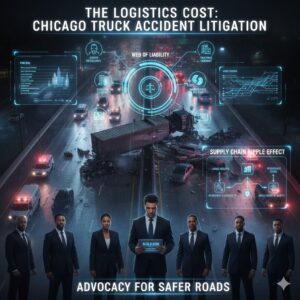
Chicago’s identity is inextricably linked to its role as the nation’s freight railroad hub, but its highways are the vital arteries that keep goods moving from coast to coast. The constant flow of semi-trucks through the region is a testament to economic vitality, but it also brings immense risk. When a catastrophic truck accident occurs on the Dan Ryan or the Eisenhower, the immediate human tragedy is paramount—but the ripple effects quickly extend into the complex web of the national supply chain. The subsequent litigation does more than seek justice for victims; it exposes the financial and operational pressures within the trucking industry, imposes accountability on carriers who cut corners, and ultimately forces a reckoning with the true cost of moving goods at the speed and price the market demands. This legal process is a critical, if often overlooked, regulator of logistics safety.
Unpacking the Complex Web of Liability in Commercial Trucking
A truck accident is rarely a simple two-vehicle collision. It is an event that invites scrutiny of an entire commercial operation. Litigation must untangle a web of potential defendants: the driver (for fatigue, distraction, or error), the trucking company (for negligent hiring, training, or hours-of-service violations), the cargo loader (for improper weight distribution or securing), the leasing company, and the manufacturers of the truck, trailer, or parts (for mechanical failure). This requires legal teams with specific knowledge of Federal Motor Carrier Safety Regulations (FMCSRs) and the resources to conduct a forensic investigation. They subpoena electronic logging device (ELD) data, maintenance records, driver qualification files, and company safety policies. This depth of discovery is what transforms a tragic accident into a case with the power to change corporate behavior across the industry.
The Discovery of Systemic Pressure and Negligence
The discovery phase in major truck accident litigation often reveals a pattern of systemic issues rather than a one-time driver mistake. It may show a carrier routinely encouraging or ignoring hours-of-service violations to meet deadlines, failing to maintain brakes or tires, or using unqualified drivers to keep costs low. This evidence shifts the case from individual negligence to corporate misconduct. For the victims and their families, this is a crucial distinction—it means the harm was preventable and rooted in a profit-over-safety calculation. Presenting this pattern to a jury not only justifies substantial punitive damages but also serves a public good by making the hidden costs of cheap freight visible. The multi-million dollar verdict is not just compensation; it’s a market correction.
The Ripple Effect on Supply Chain Reliability and Costs
A major lawsuit against a trucking company has direct business implications. Large verdicts or settlements affect the carrier’s insurance premiums and can impact their operating authority. This creates a direct financial incentive for the entire industry to invest in safety technology (like automatic emergency braking), rigorous driver training, and strict compliance programs. While this may contribute marginally to shipping costs, it is the price of reducing externalities—the human and economic toll of crashes borne by the public. Furthermore, by holding companies accountable, litigation helps level the competitive playing field, preventing unethical carriers from undercutting safer rivals by ignoring regulations. In this way, the work of a dedicated Chicago truck accident lawyer indirectly supports the responsible actors in the logistics industry and contributes to a more stable and predictable supply chain.
Advocacy for Victims as Advocacy for Safer Roads
For the individual or family devastated by a truck crash, the legal journey is about securing a future that covers immense medical bills, lost income, and lifelong care needs. Firms that take on these complex cases provide a service that goes beyond the courtroom. They become advocates for safety reforms, sometimes using the evidence uncovered in litigation to petition for stricter state or federal regulations. They give a voice to victims in a system where trucking companies have powerful lobbying arms. Every successfully litigated case sends a market signal that negligence has a price—a price high enough to make investment in prevention the smarter business decision. In a city like Chicago, where the hum of truck traffic is the sound of economic lifeblood, this form of legal accountability is an essential check, ensuring that the movement of goods does not come at the unacceptable cost of human lives.