Understanding Liability in Personal Injury Law
 Winter in April 2026 still brings unexpected challenges, especially when icy walkways create hidden dangers. A sudden slip and fall on a frozen path can lead to serious injuries, medical bills, and a host of legal questions. Understanding who is responsible for clearing these hazards is crucial for everyone.
We know that navigating the aftermath of such an accident can be overwhelming. This extensive guide is here to help. We will break down the complexities of a “frozen walkway slip claim.”
We will explore who holds legal responsibility for maintaining safe walkways, from property owners to municipalities. You will learn about key legal concepts like premises liability and the “natural accumulation” rule. We’ll also cover the essential evidence needed to prove negligence and how comparative fault might affect your claim. Understanding premises liability, especially in cases involving Frozen walkway personal injury law, can be an important first step.
Our goal is to provide a clear, comprehensive understanding of your rights and responsibilities. This information will empower you to act informed, whether you are preventing accidents or seeking justice after one.

When a slip and fall occurs on an icy surface, the immediate question often revolves around who is legally responsible. This falls under the umbrella of premises liability law, which dictates that property owners have a duty to maintain a safe environment for visitors. However, the extent of this duty can vary significantly depending on the type of property, the nature of the ice, and local regulations.
Generally, property owners are expected to exercise “reasonable care” to prevent foreseeable hazards. This includes taking steps to remove or mitigate dangerous conditions like ice and snow. This responsibility can extend to private homeowners, commercial businesses, landlords, and even municipalities. For instance, a business inviting customers onto its premises typically has a higher duty of care than a private homeowner. Tenants, too, might have responsibilities depending on their lease agreements regarding common areas or the specific portions of the property they occupy.
The core principle in determining liability is whether the property owner knew, or should have known, about the hazardous condition and failed to take appropriate action within a reasonable timeframe. This concept of “notice” is critical in any frozen walkway slip claim. Without proving that the property owner had notice of the hazard, it becomes challenging to establish negligence.
The Concept of Constructive Notice in Personal Injury Law
Proving that a property owner had “notice” of a dangerous icy condition can be established in two primary ways: actual notice or constructive notice. Actual notice means the property owner was directly aware of the ice – perhaps they saw it, were told about it, or even created it. Constructive notice, however, is more common and often more complex to prove.
Constructive notice implies that the hazardous condition existed for such a period that a reasonably prudent property owner, exercising ordinary care, should have discovered and remedied it. Factors influencing constructive notice include the length of time the ice was present, its visibility, and whether the owner conducted regular inspections or maintenance. For example, if a large patch of ice formed overnight and remained untreated for several hours during business operations, a court might determine that the owner had constructive notice. Maintenance logs, inspection schedules, and even witness testimonies about the duration of the hazard can be crucial evidence in establishing constructive notice.
Duty of Care for Residential vs. Commercial Properties
The legal “duty of care” owed by a property owner can differ significantly based on the nature of the property and the status of the person who slipped. Commercial properties, such as stores, restaurants, or office buildings, generally owe the highest duty of care to their visitors, often referred to as “invitees.” These businesses are expected to actively inspect their premises for hazards, promptly address them, and provide warnings when necessary. This higher standard reflects the fact that these businesses invite the public onto their property for commercial gain.
In contrast, residential property owners, particularly private homeowners, may have a slightly different standard. While they still must act with reasonable care, they might not be expected to conduct the same rigorous inspections as a commercial entity. However, if they create an artificial condition that leads to ice (e.g., a leaky gutter that drips onto a walkway and freezes), or if they are aware of a hazard and fail to address it, they can still be held liable. Landlords of apartment complexes or rental properties also have a duty to maintain common areas, such as shared walkways and parking lots, in a safe condition. The specific safety standards and expectations often hinge on whether the injured party was an invitee, licensee, or trespasser, each category carrying different legal implications regarding the duty owed.
The “Frozen Walkway Slip Claim”: A Case Study in Premises Liability
A frozen walkway slip claim often hinges on nuanced legal distinctions, particularly concerning how the ice formed and the property owner’s response. Not every icy patch automatically leads to liability. Key doctrines, such as the “natural accumulation” rule and the “ongoing storm doctrine,” play a significant role in determining fault.
Natural Accumulation vs. Artificial Conditions
One of the most critical concepts in an ice slip and fall case is the “natural accumulation” rule. In many jurisdictions, property owners are generally not held liable for injuries resulting from the natural accumulation of snow and ice. This means if snow falls, melts, and refreezes naturally, or if ice forms due to ordinary weather conditions, the owner might not be responsible. The rationale is that winter weather is an expected condition, and expecting property owners to keep every surface completely free of natural ice at all times is often deemed unreasonable.
However, this rule has significant exceptions. Liability often arises when the snow or ice is no longer a “natural accumulation” but rather an “artificial condition” created or aggravated by the property owner’s actions or inactions. For example, if a property owner improperly clears snow, creating uneven piles that melt and refreeze, or if a faulty downspout diverts water onto a walkway where it freezes, this could be considered an artificial condition. Similarly, if an owner attempts to remove ice but does so negligently, making the condition worse, they could be held liable. The distinction between natural and artificial accumulation is frequently a point of contention in these cases.
Ongoing Storm Doctrine and Reasonable Time
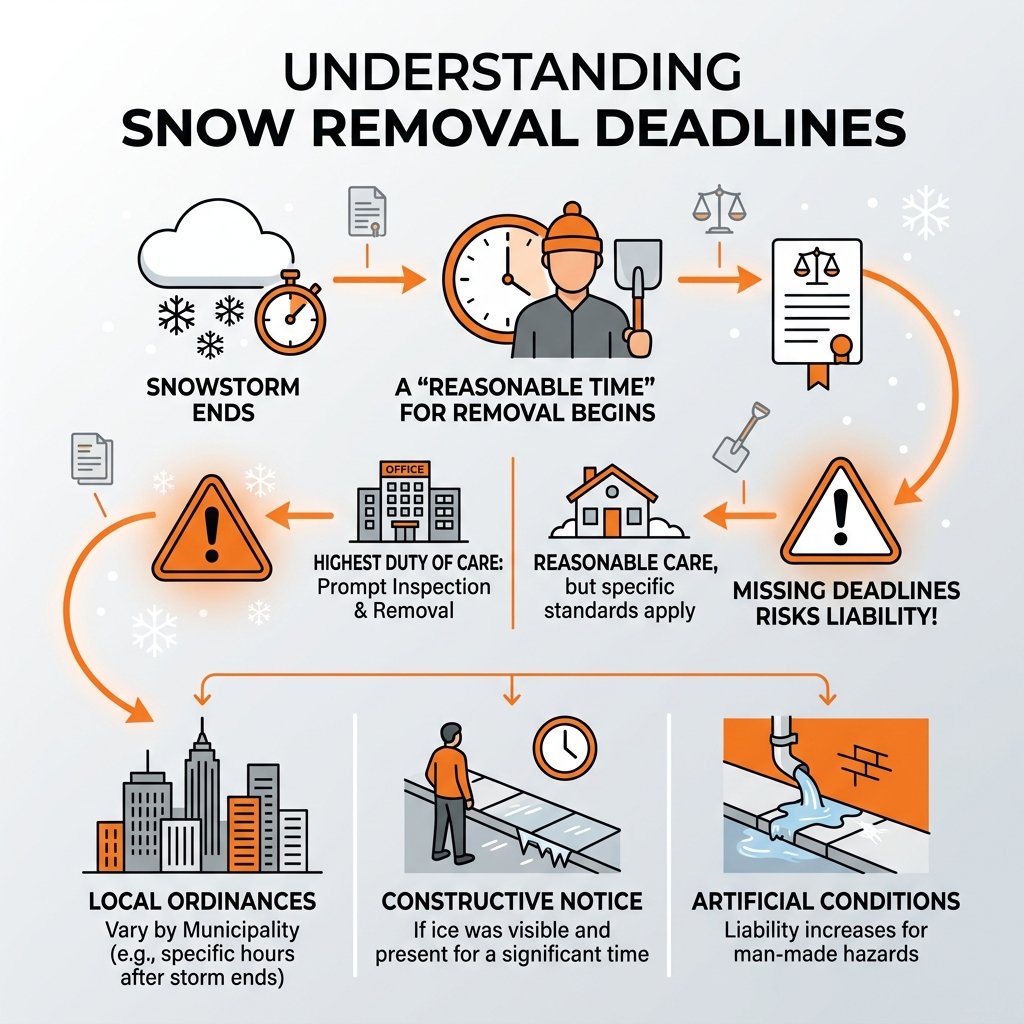
Another crucial defense for property owners is the “ongoing storm doctrine.” This legal principle generally states that a property owner is not liable for injuries caused by snow or ice accumulation during an active storm or for a reasonable period immediately following its cessation. Courts recognize that it is impractical and often unsafe to expect property owners to continuously clear snow and ice while a storm is still in progress.
Once a storm ends, however, the property owner’s duty to clear the hazard commences. The question then becomes, “What constitutes a ‘reasonable time’ for removal?” There’s no universal answer, as it depends on various factors, including the severity of the storm, the amount of accumulation, the time of day the storm ended, the resources available to the property owner, and local ordinances. Some jurisdictions might specify a timeframe, such as 12 or 24 hours after a storm ends, for snow and ice removal. Failing to comply with these local ordinances can significantly increase a property owner’s liability. For instance, in Connecticut, which averages nearly 37 inches of snow per year, property owners are generally expected to clear snow and ice within a reasonable time, often interpreted as 24 hours after a storm. This doctrine acknowledges the practical challenges of winter weather while still upholding the owner’s ultimate responsibility for safety.
Local ordinances play a pivotal role in defining these responsibilities. Many municipalities have specific bylaws regarding snow and ice removal from sidewalks abutting private property. While Wisconsin law, for example, often protects homeowners from liability for natural snow/ice on public sidewalks despite municipal ordinances, businesses are held to a higher standard under the Safe Place Statute. Conversely, in New York City, Administrative Code 7-210 shifts liability for sidewalk maintenance, including snow and ice removal, to the abutting property owner, with specific deadlines for clearance. These deadlines can vary, requiring removal within a few hours if snowfall ends during the day, or by a specific morning hour if it snows overnight. Understanding these varied local rules is essential for both property owners and potential claimants.
The Impact of the “Open and Obvious” Doctrine
The “open and obvious” doctrine can significantly impact a frozen walkway slip claim. This legal principle suggests that if a hazardous condition, such as a large patch of ice, is so apparent and visible that any reasonable person would have seen and avoided it, the property owner’s duty to warn or protect against that hazard may be reduced or eliminated. The rationale is that individuals are expected to exercise reasonable care for their own safety.
If the ice was clearly visible, and there were alternative, safer paths available that the injured party chose not to take, a court might find that the hazard was “open and obvious.” In such cases, the responsibility for the fall could shift, at least partially, to the injured person. However, the application of this doctrine is not always straightforward. Factors like “black ice,” which is difficult to see, or situations where there were no reasonable alternative paths, can complicate this defense. For example, if a property owner creates an artificial condition like ice from a diverted downspout, even if it’s visible, the owner’s negligence in creating the hazard might still override the “open and obvious” defense. The visibility of the hazard and the plaintiff’s awareness of the risk are key considerations.
Essential Evidence and Proving Negligence

To successfully pursue a frozen walkway slip claim, proving negligence is paramount. This requires a meticulous collection and presentation of evidence that demonstrates the property owner breached their duty of care, and that this breach directly caused your injuries. We cannot overstate the importance of thorough documentation immediately following an accident.
The evidence needed typically includes:
- Photographs and Videos: Visual documentation of the scene, the ice, and surrounding conditions.
- Weather Reports: Official records to establish the timing of the storm and temperatures.
- Witness Statements: Accounts from anyone who saw the fall or the hazardous condition prior to it.
- Surveillance Footage: If available from nearby businesses or security cameras.
- Medical Records: Comprehensive documentation of injuries, treatment, and prognosis.
- Maintenance Records: Proof of the property owner’s snow and ice removal efforts, or lack thereof.
Without concrete evidence, it becomes challenging to establish the property owner’s liability. For those in California seeking legal guidance, especially in areas like Mission Viejo, documenting these details is crucial for a potential claim. An experienced legal team, such as a Slip & Fall Accident Lawyer Mission Viejo, can help victims understand their rights and the evidence required. Similarly, for Spanish-speaking clients, an Abogado de Resbalón y Caída en Mission Viejo or an Abogado de Propiedades Peligrosas en Mission Viejo can provide essential support in gathering and presenting this evidence.
Documenting the Scene of a Frozen Walkway Slip Claim
The moments immediately following an icy slip and fall are critical for gathering evidence. If you are able, or if a companion can assist, documenting the scene effectively can make a significant difference in your claim. We recommend taking numerous photos and videos from various angles.
Focus on:
- The Ice Itself: Capture the size, thickness, texture, and color of the ice. Is it clear, black ice, or covered by a thin layer of snow?
- Surrounding Area: Show the immediate vicinity, including any drainage issues, downspouts, uneven surfaces, or objects that might have contributed to the ice formation.
- Lighting Conditions: Document how well-lit the area was.
- Warning Signs: Note the presence or absence of “wet floor” or “caution ice” signs.
- Footwear: Take a picture of the shoes you were wearing.
- Landmarks: Include identifiable landmarks (buildings, street signs) to establish the exact location.
- Time and Date: Ensure photos and videos are time-stamped.
Witnesses are also invaluable. Obtain their names and contact information, as their testimony can corroborate your account of the conditions and the fall. Reporting the incident to the property owner, manager, or landlord immediately is also crucial. This creates an official record of the accident. Conditions can change rapidly, especially after an ice storm, so prompt documentation is essential.
The Role of Expert Testimony
In complex frozen walkway slip claims, expert testimony can be indispensable for establishing negligence and causation. These professionals provide specialized knowledge that helps a jury or judge understand intricate details beyond common experience.
Key experts often include:
- Meteorologists: They can provide detailed weather data, including temperature fluctuations, precipitation, and freeze-thaw cycles leading up to the accident. This helps determine when the ice formed and how long it was present, crucial for establishing constructive notice.
- Safety Engineers/Forensic Engineers: These experts can analyze the property’s design, maintenance practices, and the specific conditions that led to the fall. They can testify on whether the property owner adhered to industry standards for snow and ice removal, or if structural issues (like poor drainage) created the hazard.
- Medical Professionals: Doctors, orthopedic surgeons, neurologists, and physical therapists can detail the nature and extent of your injuries, explain the long-term impact, and link them directly to the slip and fall incident. This is vital for proving causation and calculating damages.
- Economic Experts: In cases involving significant lost wages or future earning capacity, economists can project financial losses, including medical expenses, rehabilitation costs, and diminished earning potential.
The insights provided by these experts can strengthen your case, counter defense arguments, and significantly influence the outcome of your claim.
Compensation and the Role of Comparative Fault
When you sustain injuries from a frozen walkway slip and fall, understanding the types of compensation you can recover and how your own actions might affect that recovery is critical. The goal of a personal injury claim is to make the injured party whole again, as much as possible, through financial compensation.
Compensation generally falls into two categories:
- Economic Damages: These are quantifiable financial losses, including:
- Medical Bills: Past and future expenses for doctor visits, hospital stays, surgeries, medications, physical therapy, and rehabilitation.
- Lost Wages: Income lost due to time off work for recovery, and potential future lost earning capacity if the injury results in long-term disability.
- Other Out-of-Pocket Expenses: Costs for transportation to medical appointments, home modifications, or assistive devices.
- Non-Economic Damages: These are subjective, non-monetary losses, including:
- Pain and Suffering: Compensation for physical pain, discomfort, and emotional distress caused by the injury.
- Emotional Distress: Anxiety, depression, fear, or PTSD resulting from the accident.
- Loss of Enjoyment of Life: Compensation for the inability to participate in hobbies, activities, or daily routines you enjoyed before the injury.
- Permanent Disability/Disfigurement: Compensation for lasting physical impairments or scarring.
In some rare cases of extreme negligence, punitive damages might also be awarded, intended to punish the at-fault party and deter similar conduct. For those in Orange County, California, navigating such claims requires experienced legal counsel. Firms specializing in Orange County Premises Liability can provide valuable assistance in assessing potential compensation.
How Comparative Negligence Affects a Personal Injury Law Case
The concept of “comparative negligence” is a crucial factor in most slip and fall cases, particularly those involving frozen walkways. It addresses situations where the injured party may also bear some degree of fault for their accident. Most states follow some form of comparative negligence, which allows an injured person to recover damages even if they were partially at fault, but their compensation will be reduced proportionally to their degree of fault.
There are generally two types of comparative negligence rules:
- Pure Comparative Negligence: In states with this rule, an injured party can recover damages regardless of their percentage of fault, even if they are 99% responsible. However, their compensation will be reduced by their percentage of fault.
- Modified Comparative Negligence: Most states, including Connecticut and Massachusetts, follow a modified comparative negligence rule, often with a “51% bar rule.” Under this rule, an injured party can recover damages if their fault is less than 50% (or in some states, 51%). If their fault meets or exceeds this threshold, they are barred from recovering any compensation. For example, if a jury determines you were 20% at fault for not watching your step on an icy path, and your total damages are $100,000, your recovery would be reduced by 20% to $80,000. If you were found 51% at fault, you would recover nothing.
The defense will often attempt to argue that the plaintiff was negligent, perhaps by wearing inappropriate footwear, being distracted, or failing to observe an “open and obvious” hazard. Understanding how comparative negligence applies in your specific jurisdiction is vital, as it can significantly impact the final settlement or award.
Understanding the Statute of Limitations in 2026
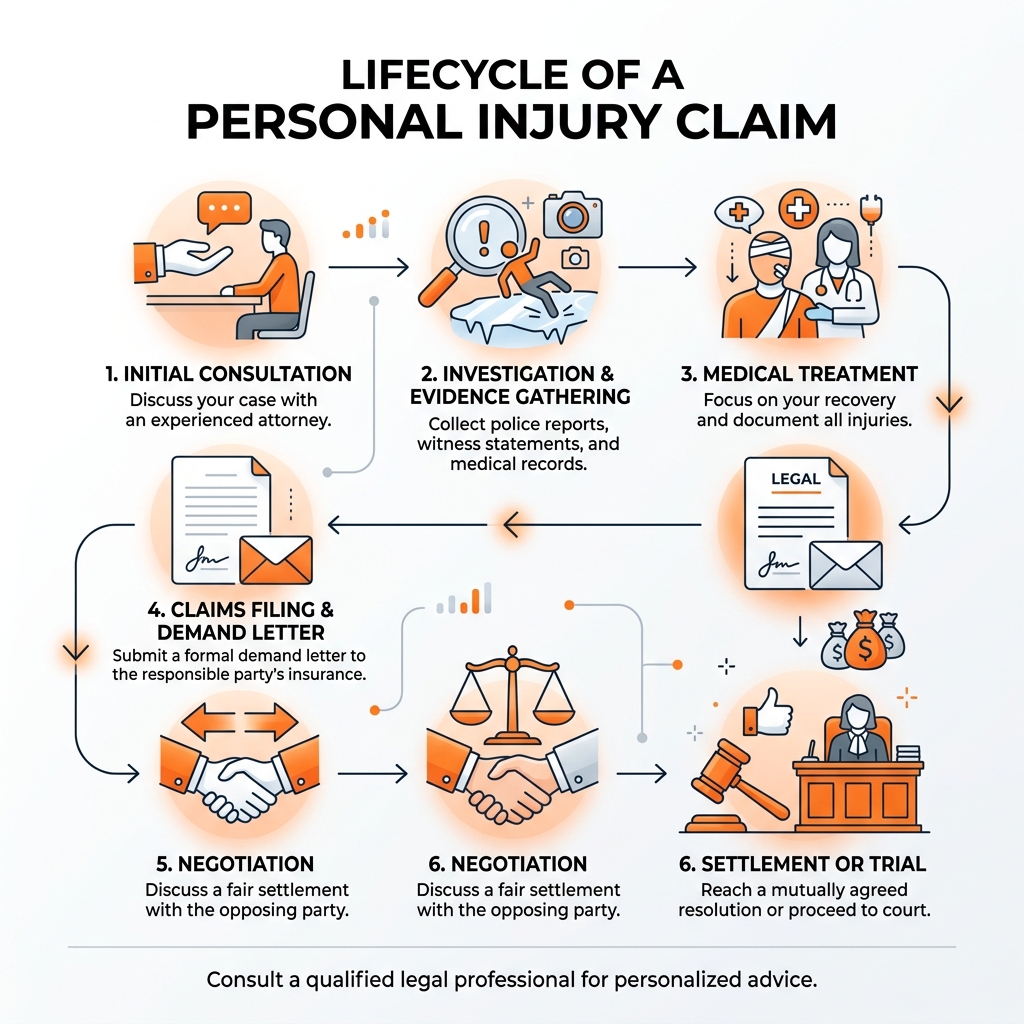
The “statute of limitations” is a strict legal deadline for filing a lawsuit after an injury. Missing this deadline, even by a single day, typically results in the permanent loss of your right to pursue a claim, regardless of how strong your case might be. These deadlines vary significantly by state and sometimes by the type of defendant.
For frozen walkway slip claims, the statute of limitations typically ranges from two to three years from the date of the accident. For example, in Connecticut, the statute of limitations for personal injury claims is generally two years, while in Massachusetts, it is three years.
However, there are critical exceptions and nuances:
- Government Entities: If your slip and fall occurred on property owned by a municipality, state, or federal government, the deadlines are often much shorter. Many jurisdictions require a “notice of claim” to be filed within a very short period, sometimes as little as 30 or 90 days, before a lawsuit can even be considered. Failing to file this initial notice within the strict timeframe can bar your claim entirely. For example, in Ontario, Canada, there are specific “short notice rules” for sidewalk snow and ice claims against municipalities.
- Discovery Rule: In some instances, if an injury is not immediately apparent, the statute of limitations might begin when the injury is “discovered” or reasonably should have been discovered. This is less common in slip and fall cases where injuries are usually immediate.
- Tolling Periods: Certain circumstances, such as the injured party being a minor or mentally incapacitated, can “toll” or pause the statute of limitations until the condition changes.
Given these complexities, it is imperative to contact a personal injury attorney as soon as possible after an icy slip and fall. They can accurately determine the applicable deadlines for your specific case and ensure all necessary filings are made on time.
Frequently Asked Questions about Personal Injury Law
What is the statute of limitations for a frozen walkway slip claim?
As of April 2026, the statute of limitations for a frozen walkway slip claim varies by state. Most states have a two-year or three-year limit from the date of the accident. For instance, Connecticut typically has a two-year statute, while Massachusetts allows three years. However, if the claim is against a government entity (like a city or county), there are often much shorter “notice of claim” requirements, sometimes as brief as 30 or 90 days, which must be met before a lawsuit can be filed. Missing these deadlines can permanently forfeit your right to pursue compensation. It’s crucial to consult with a personal injury attorney promptly to determine the exact deadlines applicable to your specific situation.
How does comparative negligence affect a personal injury law case?
Comparative negligence significantly impacts the amount of compensation you can recover in a frozen walkway slip claim if you are found to be partially at fault for your accident. Most states operate under a modified comparative negligence system, often with a “51% bar rule.” This means if a jury or court determines you were 50% or less at fault, you can still recover damages, but your award will be reduced by your percentage of fault. For example, if your damages are $100,000 and you are found 20% at fault, you would receive $80,000. However, if you are found to be 51% or more at fault, you would typically be barred from recovering any compensation. A few states follow pure comparative negligence, allowing recovery even if you are mostly at fault, with your damages reduced proportionally. Your attorney will explain how these rules apply in your state and how they might affect your potential settlement or award.
Can I sue for a slip and fall during an active snowstorm?
Suing for a slip and fall during an active snowstorm is generally more challenging due to the “ongoing storm doctrine.” This legal principle often provides a defense for property owners, stating that they are not usually liable for injuries caused by snow or ice accumulation while a storm is still in progress, or for a reasonable period immediately after it ends. The rationale is that it’s impractical to expect property owners to keep surfaces completely clear during continuous precipitation. However, there are exceptions. If the property owner’s actions (or inactions) created an artificial hazard that contributed to the fall, even during a storm (e.g., a pre-existing faulty drainage system exacerbating ice formation), liability might still be established. The specific circumstances of your fall, the nature of the hazard, and local laws will all play a role in determining the viability of such a claim.
Conclusion
Navigating a frozen walkway slip claim in April 2026 requires a thorough understanding of premises liability law, local ordinances, and the critical role of evidence. From distinguishing between natural accumulation and artificial hazards to understanding the nuances of comparative negligence and the strictures of the statute of limitations, the legal landscape can be complex.
We have seen that property owners, whether residential, commercial, or municipal, owe a duty of care to ensure their premises are reasonably safe. When this duty is breached, leading to an icy slip and fall, victims may have legal recourse to recover compensation for their injuries, medical bills, lost wages, and pain and suffering.
The key takeaways for anyone involved in such an incident are clear: prioritize your health by seeking immediate medical attention, preserve crucial evidence through photos, videos, and witness statements, and understand the impact of your own actions on the claim. Given the complexities of proving negligence, establishing constructive notice, and adhering to strict legal deadlines, professional legal consultation is almost always advisable.
If you or a loved one has suffered an injury due to a frozen walkway, understanding your rights and options is the first step toward recovery. We encourage you to seek guidance from an experienced legal professional who can evaluate your specific situation, navigate the legal process, and advocate for the justice and compensation you deserve. For comprehensive information and legal assistance regarding premises liability, we invite you to visit our dedicated page: Premises Liability Lawyer.