
The Foundations of Family Law and Divorce
The concept of marriage, at its core, is a legal contract, and its dissolution is therefore a legal process. When a marriage experiences what the law terms a “marriage breakdown” with “no reconciliation” possible, the legal system provides mechanisms for its formal end. This foundational understanding is crucial for anyone considering or undergoing a divorce.

Jurisdictional rules, such as residency requirements, dictate where a divorce can be filed. For instance, in Nova Scotia, one of the key requirements is that either you or your spouse must have lived in the province for at least one year immediately before applying for a divorce. This ensures a connection to the local legal system.
The outcome of a successful divorce application typically involves several key legal documents: a Divorce Order, which legally ends the marriage; a Corollary Relief Order, which addresses associated issues like child support, spousal support, and property division; and a Divorce Certificate, a document proving that the divorce has been finalized, often required for remarriage. Common-law couples, while they may separate and divide assets, cannot obtain a “divorce” in the legal sense, as they were never legally married. For those seeking comprehensive resources to navigate the legal aspects of divorce, an Online family law divorce platform can provide valuable insights into the process.
Grounds for Family Law and Divorce in Modern Jurisdictions
In Canada, the Divorce Act outlines the grounds for divorce, which center on the “breakdown of marriage.” This breakdown can be established in three ways:
- One-Year Separation: This is the most common ground. It requires that the spouses have lived separately and apart for at least one year immediately preceding the determination of the divorce proceeding. Importantly, the separation is “fact-based,” meaning it doesn’t require a formal legal document to prove; it’s about the couple living apart with the intention that the marriage will end. Brief attempts at reconciliation (up to 90 days) during this period do not necessarily restart the one-year clock.
- Adultery: If one spouse has committed adultery, the other spouse can cite this as a ground for divorce. Proving adultery can be complex and often requires detailed evidence, which can be emotionally challenging.
- Mental or Physical Cruelty: This ground requires proof of treatment by one spouse of the other of such a kind as to render intolerable the continued cohabitation of the spouses. This is a high bar to meet and typically involves severe and ongoing abuse, whether emotional, psychological, or physical.
The process typically begins with one spouse (the Petitioner) filing a Petition for Divorce with the court. The other spouse (the Respondent) then has the opportunity to file an Answer, either agreeing to the divorce and its terms or contesting certain aspects.
Distinguishing Between Uncontested and Contested Proceedings
The path a divorce takes often depends on the level of agreement between the spouses. Understanding the difference between uncontested and contested proceedings is vital for setting expectations about timelines, costs, and emotional strain.
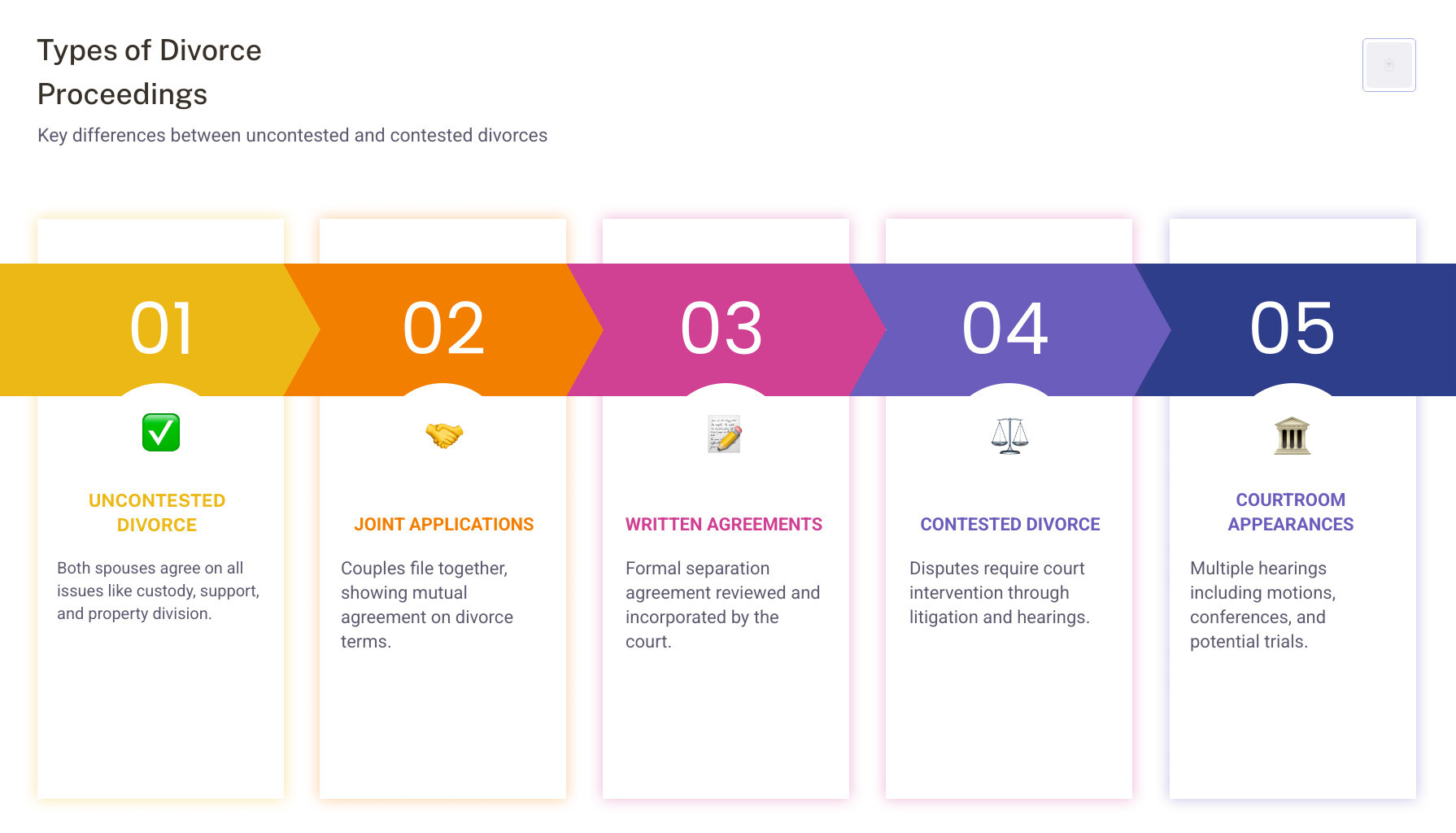
Uncontested Divorces: An uncontested divorce occurs when both spouses agree on all the key issues related to their separation, including child custody and parenting arrangements, child support, spousal support, and the division of property and debts. When there’s complete agreement, the process can be significantly streamlined.
- Joint Applications: In some jurisdictions, couples can file a joint application for divorce, indicating mutual agreement on all terms.
- Written Agreements: Spouses may formalize their agreements in a comprehensive separation agreement before filing for divorce. The court then reviews this agreement and, if deemed fair and in the best interests of any children, incorporates it into the divorce order.
- Unopposed Petitions: One spouse files a petition, and the other spouse does not contest any of the terms, allowing the divorce to proceed without opposition.
The primary advantage of an uncontested divorce is that it typically involves fewer or no courtroom appearances, is generally less expensive, and is resolved more quickly. The processing is often handled by court staff and a judge without the need for extensive litigation.
Contested Divorces: A contested divorce arises when spouses cannot agree on one or more significant issues. This disagreement necessitates court intervention to resolve the disputes.
- Litigation: This involves formal legal proceedings in which lawyers present arguments and evidence to a judge, who then decides unresolved matters.
- Courtroom Appearances: Contested divorces often involve multiple court appearances, including motions, case conferences, and potentially a full trial.
- Petitioner vs. Respondent: The spouse who initiates the divorce is the Petitioner, and the other is the Respondent. Each side typically presents its case, often leading to a more adversarial process.
The legal end to a marriage, whether uncontested or contested, always requires a court order. However, the journey to that order can vary dramatically depending on the parties’ willingness to reach a mutual understanding.
Financial Obligations and Asset Division
Divorce profoundly impacts a couple’s financial landscape, requiring a careful, often complex division of assets and debts accumulated during the marriage. The guiding principle in many jurisdictions, including Nova Scotia, is “equitable distribution,” which means fair, though not necessarily equal, division.

This process involves identifying all marital property—assets acquired by either spouse during the marriage—and distinguishing it from separate property, which typically includes assets owned before the marriage or received as gifts or inheritances. Key considerations include:
- Debt Allocation: Just as assets are divided, so are marital debts, including mortgages, credit card balances, and loans.
- Pension Division: Pensions and retirement savings accumulated during the marriage are often considered marital property and subject to division. This can involve complex calculations and specific orders to plan administrators.
- Business Assets: If one or both spouses own a business, its valuation and division can be exceptionally intricate, often requiring expert appraisal.
- Future Expenses: Divorce settlements often need to account for future financial needs, such as children’s education costs or a spouse’s retirement savings, which may impact spousal support or asset division.
- 401(k) Considerations: In jurisdictions that follow principles similar to those in the US, retirement accounts like 401(k)s are divided through Qualified Domestic Relations Orders (QDROs) to avoid immediate tax penalties.
Navigating these financial complexities requires meticulous attention to detail and often the expertise of legal professionals. For individuals facing intricate financial decisions, especially those involving asset division and support, consulting with a knowledgeable Salt Lake divorce attorney can provide crucial guidance and advocacy tailored to their specific situation.
Calculating Child Support and Spousal Maintenance
Child Support: In Canada, child support is primarily calculated using the Federal Child Support Guidelines, which are applied consistently across provinces, including Nova Scotia. The calculation is based primarily on the payor parent’s gross annual income from all sources and the number of children. These guidelines are presented in “table look-ups” that provide a base amount.
- Income Guidelines: The tables specify the basic monthly support amount based on the payor’s income and province of residence. If the payor lives outside Canada, the recipient’s province of residence is often used as the basis for the calculation.
- Special or Extraordinary Expenses: Beyond the table amounts, additional expenses for children, such as childcare, medical/dental insurance premiums, health-related payments, post-secondary education, and extracurricular activities, are typically shared proportionally to the parents’ incomes.
- Recalculation Services: Some provinces offer child support recalculation services that update support amounts annually without requiring a new court application, ensuring that support remains fair as incomes change.
- Enforcement Programs: Provincial agencies enforce child support orders, ensuring payments are made as stipulated by the court.
Spousal Maintenance (Alimony): Spousal support, often referred to as alimony, is less formulaic than child support. While there are Spousal Support Advisory Guidelines in Canada, they are not legally binding but provide a framework for negotiation and judicial decision-making. Factors considered include:
- Financial Need and Capacity: The income, assets, and financial needs of both spouses.
- Duration of Marriage: Longer marriages often result in more extended periods of support.
- Roles During Marriage: Contributions to the marriage, including childcare and household management, and their impact on earning capacity.
- Impact of Divorce: The economic consequences of the divorce for each spouse.
- Self-Sufficiency: The goal is often to help the recipient spouse become financially self-sufficient within a reasonable period of time.
- Job Prospects: The current and future earning potential of both parties.
Essential Financial Disclosures in Family Law and Divorce
Transparency is paramount in financial matters during a divorce. Both parties are typically required to provide complete and frank financial disclosures to ensure that decisions regarding child support, spousal support, and property division are based on accurate and complete information. Common disclosures include:
- Tax Returns: Income tax returns and notices of assessment for the past several years (often three years).
- Asset Valuation: Documentation proving the value of all assets, such as bank statements, investment account statements, property appraisals, vehicle valuations, and pension statements.
- Debt Documentation: Statements for all debts, including credit cards, lines of credit, mortgages, and personal loans.
- Pay Stubs and Employment Records: Recent pay stubs, employment contracts, and records of bonuses or commissions.
- Business Records: If applicable, financial statements, tax returns, and valuation reports for any businesses owned.
In many jurisdictions, a “Direction to Disclose” may be issued by the court, compelling parties to provide specific financial documents. Failure to provide complete and accurate financial information can lead to severe consequences, including adverse court orders, cost awards, or even the setting aside of a settlement agreement. In complex cases, especially where there’s suspicion of hidden assets or underreported income, engaging a professional accountant or forensic auditor can be invaluable. This meticulous approach to financial disclosure ensures fairness and prevents future disputes arising from incomplete information.
Modern Parenting and Expanding Family Structures
The landscape of family has evolved, and family law continually adapts to reflect these changes. When parents separate or divorce, the paramount consideration is always the “best interests of the child.” This principle guides all decisions related to children, from where they live to how they are raised.
The Divorce Act in Canada, for example, underwent significant changes in March 2021, shifting terminology from “custody and access” to “parenting arrangements.” This change emphasizes a child-focused approach, encouraging parents to cooperate rather than engage in adversarial battles over “possession” of their children.
- Parenting Arrangements: These outline how parents will share responsibilities for their children, including where the children will primarily reside (residential schedule) and how time will be divided between parents.
- Shared Parenting: This refers to arrangements where children spend substantially equal time with both parents.
- Decision-Making Authority: This specifies how parents will make important decisions about their children’s upbringing, such as education, health care, and religious instruction. It can be shared jointly or allocated to one parent for specific areas.
- Travel Consent: When one parent wishes to travel internationally with children, explicit consent from the other parent (or a court order) is often required to prevent international child abduction.
- Relocation Rules: If a parent intends to move a significant distance with the children, often across provincial or international borders, specific legal procedures and considerations apply, again centering on the child’s best interests.
Adoption Pathways and Consent Requirements
Adoption is a legal process that permanently transfers parental rights and responsibilities from birth parents to adoptive parents, creating a new legal family. Various pathways exist, each with its own nuances:
- Agency Adoption: Facilitated by licensed adoption agencies, which often provide counseling and support services.
- Private Placement: Arranged directly between birth parents and prospective adoptive parents, often with legal and social work assistance. Step-parent adoptions are a common form of private placement where one parent adopts the child of their spouse.
- Relative Adoption: When a relative, such as a grandparent, aunt, or uncle, adopts a child.
- International Adoption: Adopting a child from another country, which involves navigating the laws of both the child’s country of origin and the adoptive parents’ country.
Consent Requirements: A critical aspect of adoption is consent. In Nova Scotia, for non-agency adoptions, key consent requirements include:
- Adoptee Consent: If the child to be adopted is 12 years of age or older, their consent is required.
- Parental Rights Termination: The birth parents’ consent is usually required, unless a court order has terminated their parental rights due to neglect or abuse. Once an adoption is finalized, birth parents generally lose their custody and access rights, unless specific “openness agreements” are put in place, allowing for ongoing contact.
- Spousal Consent: If the adoptive parent is married, their spouse’s consent is typically needed.
Surrogacy and Assisted Reproduction Laws
Modern medicine has opened new avenues for family building, including surrogacy and assisted reproduction. In Canada, these practices are primarily governed by the federal Assisted Human Reproduction Act (AHRA).
- Altruistic Surrogacy: The AHRA permits altruistic surrogacy, where a woman carries a pregnancy for intended parents without financial compensation beyond reimbursement for approved expenses (e.g., medical costs, loss of income). Commercial surrogacy (paying a fee for the surrogacy itself) is illegal.
- Donor Agreements: For processes involving sperm, egg, or embryo donation, donor agreements are crucial. These agreements clarify the rights and responsibilities of all parties and ensure that donors understand they will not have parental rights or obligations.
- Parentage Confirmation: After a child is born via surrogacy or donor conception, legal steps are necessary to confirm the intended parents as the legal parents. This often involves court applications to declare parentage.
- Independent Legal Advice: It is strongly recommended, and often legally required, that all parties involved in surrogacy and donor agreements (intended parents, surrogate, donors) receive independent legal advice to ensure their rights and obligations are fully understood and protected.
- Fertility Clinics: These clinics play a vital role in facilitating assisted reproduction, adhering to strict regulations under the AHRA.
Legal Rights for Same-Sex Couples
Nova Scotia, like the rest of Canada, has a strong legal framework affirming the rights of same-sex couples, reflecting a commitment to equality and non-discrimination.
- Marriage Equality: Same-sex marriage has been legal across Canada since 2005, granting same-sex spouses the same rights and responsibilities as opposite-sex spouses.
- Domestic Partnerships: Nova Scotia recognizes domestic partnerships (registered under the Vital Statistics Act), providing many of the same legal protections and obligations as marriage for couples who choose not to marry.
- Parental Recognition: Same-sex parents have equal rights to recognition as legal parents, whether through birth, adoption, or assisted reproduction. Laws have evolved to ensure both parents in a same-sex couple can be recognized on birth certificates and have full parental rights.
- Adoption Rights: Same-sex couples have the right to adopt children, either jointly or as a single parent, under the same criteria as opposite-sex couples.
- Property Rights: In the event of separation or divorce, same-sex couples’ property and debt division, and spousal support entitlements, are governed by the same family law principles as opposite-sex couples.
It’s also worth noting that the age of majority in Canada is either 18 or 19, depending on the province or territory, which affects when individuals can exercise legal rights independently, including those related to marriage and parenting decisions. The age of consent for sexual activity is 16, but 18 if there is a relationship of authority, trust, or dependency, highlighting legal protections for vulnerable individuals.
Navigating Conflict and Protective Agreements
Family law matters, particularly divorce, are inherently fraught with emotional conflict. However, effective dispute-resolution strategies and protective legal agreements can mitigate harm and pave the way for more amicable, stable outcomes. Safety planning is also a crucial consideration, especially when family violence is present.
One of the most valuable insights we can offer is to be emotionally prepared for the divorce process. Many individuals make critical mistakes when overwhelmed by emotion, resulting in unfavorable long-term outcomes. We often find that healing emotionally before initiating divorce proceedings can prevent poor decisions.
It’s also critical to avoid premature agreements. While reaching a quick settlement might seem appealing, agreeing to terms without fully understanding their implications for your assets, debts, and future can be detrimental. We’ve seen situations where individuals, eager to end the process, overlook significant financial details or parenting considerations that later cause substantial regret.
Additionally, self-representation in divorce is rarely successful. The complexities of family law, the procedural rules of the court, and the emotional toll of the process often overwhelm individuals without legal training. This can lead to costly and protracted legal battles that could have been avoided with professional guidance. For a more detailed understanding of common pitfalls, consider reviewing this list:
Collaborative Family Law vs. Traditional Litigation
When disputes arise, couples have choices beyond the traditional courtroom battle:
- Collaborative Family Law: This is a team-based approach where both spouses, each represented by a specially trained collaborative lawyer, commit to resolving their issues out of court. The process often involves neutral experts (like financial specialists or child psychologists) and focuses on creative, mutually beneficial solutions. If the collaborative process fails, the lawyers must withdraw, and the parties must hire new counsel for litigation. This model prioritizes flexibility, privacy, and preserving relationships, often leading to more personalized and sustainable agreements.
- Mediation: A neutral third-party mediator helps spouses communicate, identify issues, and explore solutions. The mediator does not make decisions; they facilitate discussion. If an agreement is reached, it can be drafted into a separation agreement, which independent legal counsel should then review.
- Traditional Litigation: This involves taking the disputes to court, where a judge makes binding decisions after hearing arguments and evidence from both sides. While sometimes necessary, litigation is often the most expensive, time-consuming, and emotionally draining option, with outcomes determined by a third party.
We encourage exploring alternative dispute resolution (ADR) options, such as collaborative law and mediation, before resorting to litigation. They are often more cost-effective, allow the parties to maintain greater control, and can lead to better long-term co-parenting relationships.
The Role of Marriage Contracts and Cohabitation Agreements
Proactive legal planning can prevent significant disputes down the line. Marriage contracts (often called pre-nuptial agreements) and cohabitation agreements serve as protective frameworks for couples.
- Pre-nuptial Protections: A marriage contract, signed before or during marriage, allows couples to define how their property and debts will be divided if they separate or divorce. It can also address spousal support. This helps in “asset ring-fencing,” protecting pre-marital assets or inheritances.
- Cohabitation Agreements: For couples living together but not married, a cohabitation agreement serves a similar purpose, outlining financial arrangements, property division, and support obligations if the relationship ends.
- Domestic Partnership Declarations: In Nova Scotia, couples can register a domestic partnership, which grants them many of the same rights and responsibilities as married spouses, making cohabitation agreements particularly relevant.
- Future-Proofing: These agreements allow couples to “future-proof” their relationship, providing clarity and certainty during what can otherwise be a highly uncertain time.
- Validity Requirements: For these agreements to be legally binding, they must typically be in writing, signed by both parties, and often require each party to have received independent legal advice to ensure they understand the terms and their implications. Without independent legal advice, a court may later set aside the agreement.
Addressing Family Violence in Legal Proceedings
Family violence, in any form, has profound implications for legal proceedings, particularly concerning children and safety.
- Custody Impacts: Courts are mandated to prioritize the safety and well-being of children. Evidence of family violence will significantly impact parenting arrangements, potentially leading to supervised visitation or sole decision-making authority for the non-abusive parent.
- Supervised Visitation: In cases where there are concerns about a parent’s ability to provide a safe environment, courts may order supervised visitation, where contact with the child occurs in the presence of a third party.
- Immigration Protections: In Canada, individuals experiencing family violence do not have to remain in an abusive relationship to maintain their immigration status. This is a critical protection for newcomers.
- Reporting Duties: All adults have a legal and moral obligation to report suspected child abuse to child welfare authorities.
- Child Welfare Intervention: Child welfare agencies can intervene when children are at risk, which may include removing children from an unsafe environment or providing support services to families.
- Criminal Code Violations: Family violence often involves acts that are criminal offenses, such as assault, harassment, or uttering threats. Victims are encouraged to contact the police.
- Victim Resources: Numerous resources are available for victims of family violence, including shelters, counseling services, and legal aid.
- Safety Concerns: Courts can issue protection orders or restraining orders to ensure the safety of victims and children. When family violence is a factor, it is essential to prioritize safety planning and seek immediate legal and support services.
Frequently Asked Questions about Family Law and Divorce
What are the residency requirements for filing for divorce in Nova Scotia?
To apply for divorce in Nova Scotia, either you or your spouse must have lived in Nova Scotia for at least one year immediately before using. This establishes the necessary jurisdictional link to the province’s courts.
How is child support calculated if the payor lives outside of Canada?
If the payor parent lives outside of Canada, child support is typically calculated using the Federal Child Support Guidelines based on the recipient parent’s province of residence. The court in Nova Scotia would then apply the Nova Scotia guidelines, considering the payor’s income in their local currency, converted to Canadian dollars. Enforcement can become more complex, potentially involving international agreements or treaties.
What is the difference between a Divorce Order and a Divorce Certificate?
A Divorce Order is the court document signed by a judge that legally ends your marriage and typically outlines the terms of your divorce, including parenting arrangements, support, and property division. A Divorce Certificate, on the other hand, is a separate document issued by the court after the Divorce Order has been granted and the appeal period has passed. It serves as official proof that your divorce is final and legally recognized, and it is usually required if you wish to remarry.
Conclusion
Navigating the legal complexities of modern family transitions requires more than just understanding the law; it demands empathy, strategic thinking, and a commitment to achieving long-term stability for all involved. From the foundational requirements of divorce to the intricate calculations of financial support and the evolving landscape of parenting and family structures, each step presents unique challenges and opportunities.
Our goal in providing this extensive guide has been to empower you with knowledge, enabling you to make informed decisions that protect your rights and safeguard your family’s future. Whether you are considering a marriage contract, facing separation, or exploring adoption or surrogacy, professional consultation is invaluable. Legal guidance helps ensure your actions align with your best interests and those of your loved ones, leading to greater peace of mind as you navigate these significant life transitions.