Identifying Common IRS Tax Issues
 Receiving an IRS notice can trigger immediate anxiety. The thought of unpaid taxes or a looming audit often feels overwhelming. Many people feel lost when facing complex tax issues alone.
But financial relief and peace of mind are possible. Choosing the right professional help is crucial. This guide will show you how. We will explore what makes a service truly premier in IRS tax resolution.
We will also cover how such a service can help you. This includes understanding complex tax laws and navigating IRS procedures. We will explain common IRS collection actions, like liens, levies, and wage garnishments. Finding a trusted partner for premier IRS tax resolution can turn a daunting challenge into a manageable path toward financial stability.
The Internal Revenue Service (IRS) is a formidable entity, and receiving communication from them can be unsettling. Many individuals and businesses find themselves in challenging tax situations, often without realizing the full extent of their options or the potential consequences of inaction. Understanding the common types of IRS tax issues is the first step toward finding a resolution.
These issues can range from simple misunderstandings to complex legal battles, each requiring a custom approach. Ignoring them is rarely an option, as the IRS possesses significant power to enforce tax laws and collect outstanding debts. The good news is that for nearly every tax problem, there’s a resolution path available, especially when guided by experienced professionals.
Common IRS tax problems include:
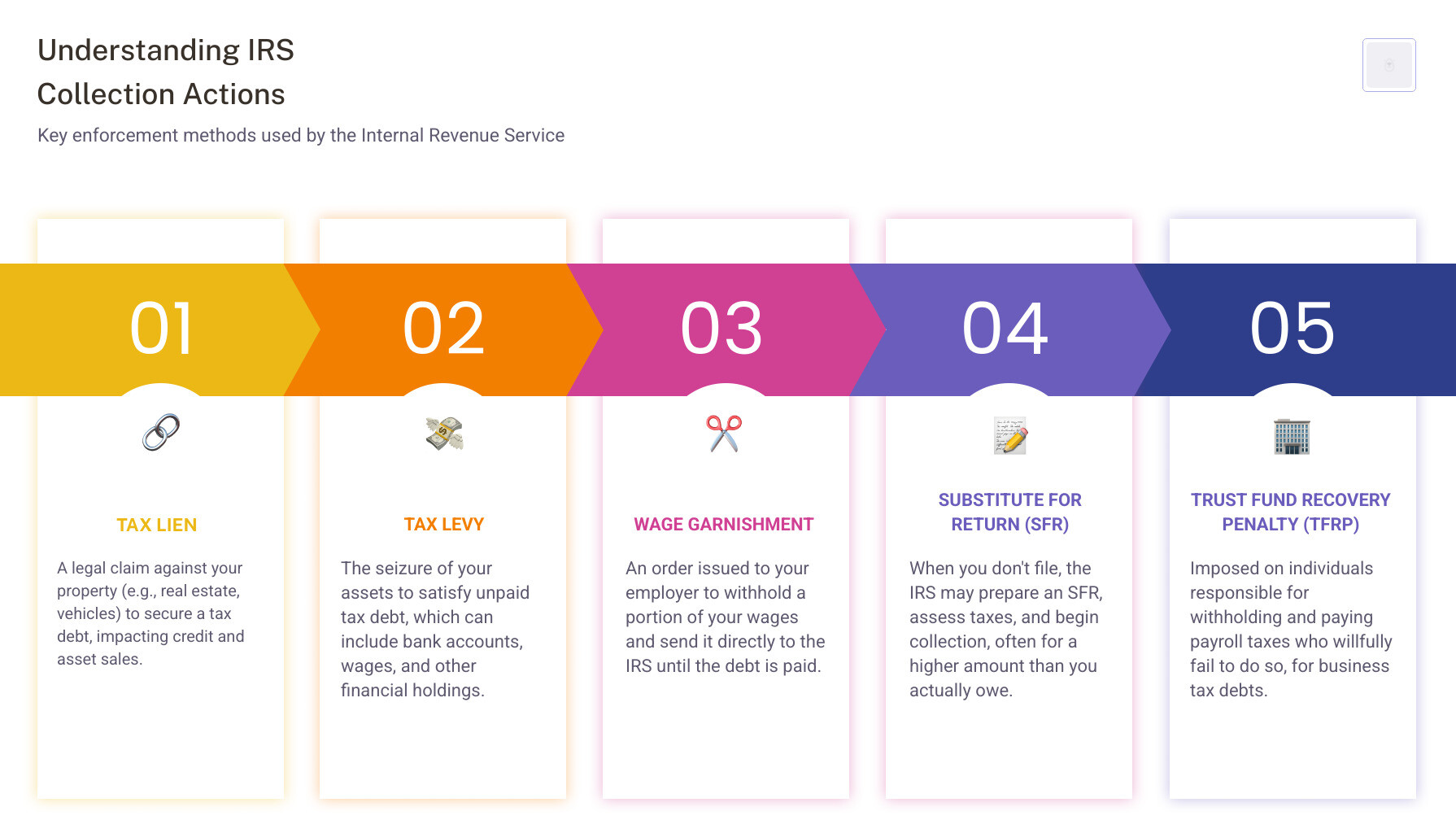
- Unfiled Tax Returns: Failing to file tax returns for one or more years can lead to significant penalties and interest. The IRS may even file a Substitute for Return (SFR) on your behalf, which often results in a higher tax liability than if you had filed your own.
- Back Taxes: This refers to taxes from previous years that were not paid on time. The longer back taxes remain unpaid, the more penalties and interest accrue, making the debt grow substantially over time.
- IRS Audit: An audit is an examination of your financial records to verify the accuracy of your tax return. Audits can be stressful and complex, potentially leading to additional tax assessments, penalties, and interest if discrepancies are found.
- Tax Lien: A tax lien is the government’s legal claim against your property when you neglect or fail to pay a tax debt. It secures the government’s interest in your property, including real estate, personal property, and financial assets.
- Tax Levy: More severe than a lien, a tax levy is the actual seizure of your property to satisfy a tax debt. This can include seizing bank accounts, garnishing wages, or taking physical assets.
- Wage Garnishment: A specific type of levy where the IRS orders your employer to withhold a portion of your wages and send it directly to the IRS until your tax debt is paid.
- Payroll Tax Problems: For businesses, failing to deposit payroll taxes (which include employee withholdings) is considered a serious offense by the IRS. This can lead to significant penalties and personal liability for responsible individuals.
- Trust Fund Recovery Penalty (TFRP): This penalty is assessed against individuals deemed responsible for collecting or paying trust fund taxes (income and Social Security/Medicare taxes withheld from employees) who willfully fail to do so. It equals the full amount of the unpaid trust fund tax.
Addressing these issues proactively is vital. The IRS provides resources to help taxpayers, including information on how to get help with tax debt. However, navigating these options often requires a deep understanding of tax law and IRS procedures.
Understanding IRS Liens and Levies
When tax debts go unpaid, the IRS has powerful tools at its disposal to collect what is owed. Among the most impactful are tax liens and tax levies, which can significantly disrupt an individual’s or business’s financial stability.
A Federal Tax Lien is essentially a legal claim against your property. It’s the government’s way of securing its interest in your assets when you fail to pay a tax debt. This claim applies to all your current and future property and rights to property, including real estate, vehicles, and financial accounts. The lien automatically comes into existence if you don’t pay your amount due after receiving your first bill. While a lien doesn’t immediately seize your property, it serves as a public notice that the IRS has a claim against your assets. This public notice can severely impact your credit report, making it difficult to obtain loans, sell property, or engage in other financial transactions. For a comprehensive understanding of the collection process, including liens, refer to Publication 594: The IRS Collection Process.
A Tax Levy, on the other hand, is a more aggressive collection action. It’s the actual seizure of your property or rights to property to satisfy your tax debt. If the IRS issues a levy, it means they are taking possession of your assets. This can include:
- Bank Accounts: Funds can be frozen and seized from your bank accounts.
- Wages: A portion of your paycheck can be garnished directly from your employer.
- Federal Payments: Government payments, such as Social Security benefits, can be intercepted.
- Physical Property: The IRS can seize and sell physical assets like cars, boats, or even real estate.
The distinction is crucial: a lien is a claim on property, while a levy is the act of seizing property. The IRS typically issues a Notice of Intent to Levy, giving you a period (usually 30 days) to respond before taking action. Understanding these mechanisms is critical for anyone facing tax debt, as they represent serious threats to financial security.
The Challenge of IRS Audits and Unfiled Returns
Two other significant challenges taxpayers face are IRS audits and the repercussions of unfiled tax returns. Both can lead to considerable stress and financial penalties if not handled correctly.
An IRS Audit is a review of your financial information to ensure that your tax return was filed accurately and in compliance with tax laws. Audits can vary in scope and intensity:
- Correspondence Audit: The most common type, usually conducted by mail, where the IRS requests documentation to verify specific items on your return.
- Office Audit: Requires you to visit an IRS office for an interview and to present records. These are typically for more complex issues than correspondence audits.
- Field Audit: The most comprehensive type, where an IRS agent visits your home, place of business, or accountant’s office to examine your books and records. These are usually reserved for businesses or complex individual returns.
Regardless of the type, an audit can be daunting. Without proper representation, taxpayers may inadvertently provide too much information or fail to present their case effectively, potentially leading to increased tax liabilities, penalties, and interest.
Unfiled Tax Returns pose a different, yet equally serious, problem. Many taxpayers, due to oversight, confusion, or financial hardship, fail to file their returns. The consequences of unfiled returns can be severe:
- Failure-to-File Penalty: This penalty is usually much higher than the failure-to-pay penalty.
- Accruing Interest: Interest accrues on any unpaid tax from the original due date of the return until the date of payment.
- Substitute for Return (SFR): If you don’t file, the IRS may file an SFR for you based on information from employers, banks, and other third parties. These SFRs often don’t include deductions or exemptions you might be entitled to, resulting in a higher tax bill.
- Delayed Refunds: You cannot receive a refund for overpaid taxes if you haven’t filed a return.
- Criminal Charges: In extreme cases of willful failure to file or tax evasion, criminal charges can be brought.
The importance of compliance cannot be overstated. Even if you cannot pay the taxes you owe, filing your return on time is crucial to avoid the failure-to-file penalty and to start the clock on the statute of limitations for collection. Professional assistance is often invaluable in navigating audits and bringing unfiled returns into compliance, potentially mitigating penalties and securing more favorable outcomes.
What Defines a Premier IRS Tax Resolution Service?

When facing complex tax issues, the choice of a tax resolution service can significantly influence the outcome. A truly premier service stands out not just by offering solutions, but by embodying a set of core principles: expertise, trustworthiness, and a client-centric approach. But how do you identify such a service amid a crowded market? We believe it comes down to several key factors that differentiate the best from the rest.
A premier service offers more than just technical knowledge; it provides a comprehensive partnership. It understands that behind every tax problem is a person or a business seeking genuine relief and a clear path forward. This means going beyond simple form-filling to offer strategic advice, proactive representation, and unwavering support. When evaluating providers, it’s always wise to consult resources like the IRS’ guidelines on choosing tax professionals to ensure you’re making an informed decision.
Essential Credentials and Experience
The foundation of any premier tax resolution service lies in the qualifications and experience of its professionals. When entrusting your financial future to a firm, you need assurance that they possess the highest level of legal and tax expertise.
- Tax Attorneys: These professionals are licensed lawyers specializing in tax law. They can represent clients in tax court, offer legal advice, and handle complex legal aspects of tax resolution. Their legal background is invaluable for navigating intricate IRS regulations and protecting client rights.
- Enrolled Agents (EAs): Enrolled Agents are federally licensed tax practitioners who have unlimited practice rights before the IRS. This means they can represent any taxpayer regarding any tax matter. Their expertise is specifically in tax law and representation.
- Certified Public Accountants (CPAs): CPAs are licensed accountants who can prepare tax returns, provide financial planning, and represent clients before the IRS (though their representation rights might be more limited than EAs or tax attorneys in certain situations).
Beyond credentials, years of experience are paramount. A firm with a long history of successfully resolving diverse tax cases demonstrates a deep understanding of IRS procedures and negotiation tactics. This experience translates into case-specific expertise, meaning they’ve likely encountered and resolved issues similar to yours, giving them a distinct advantage. Their ability to provide legal representation rights is also critical, ensuring you have a qualified advocate speaking on your behalf directly with the IRS.
Comprehensive Resolution Strategies
A premier tax resolution service doesn’t offer a one-size-fits-all solution. Instead, it provides a custom approach, leveraging a wide array of strategies to achieve the best possible outcome for each unique situation. Here are some of the key resolution options they might employ:
- Offer in Compromise (OIC): This allows certain taxpayers to resolve their tax liability with the IRS for a lower amount than what they originally owe. The IRS may accept an OIC if they determine that the taxpayer cannot pay the full amount due to their financial situation. For more detailed information, consider our Offer in Compromise Complete Guide.
- Installment Agreements: If you can’t pay your full tax liability immediately, an installment agreement allows you to make monthly payments over a period of up to 72 months. This helps avoid more aggressive collection actions while you pay off your debt.
- Penalty Abatement: The IRS may remove certain penalties if you have a reasonable cause for failing to file or pay on time. A premier service will help you build a strong case for penalty relief. Learn more in our IRS Penalty Abatement Complete Guide.
- Currently Not Collectible (CNC) Status: If the IRS determines that you cannot pay your tax debt and meet your basic living expenses, they may temporarily suspend collection efforts and place your account in CNC status.
- Innocent Spouse Relief: This relief is available to one spouse for tax liabilities arising from a joint return where the other spouse (or former spouse) was responsible for errors or omissions, and it would be unfair to hold the “innocent” spouse liable.
- IRS Audit Defense: Expert representation during an audit can protect your rights, ensure fair treatment, and help you steer the process effectively. Our IRS Audit Defense Complete Guide provides further insights.
- Tax Lien and Levy Release: Professionals can negotiate with the IRS to release liens and levies, protecting your assets and restoring your financial freedom.
These strategies are often part of the broader dispute resolution mechanisms available through the IRS. The ability of a service to analyze your specific circumstances and apply the most effective resolution tool is a hallmark of a premier provider.
A Proven Track Record and Transparent Communication
Beyond credentials and a comprehensive service offering, a premier tax resolution firm distinguishes itself through its demonstrable success and its commitment to clear, honest communication.
Case results and debt reduction statistics offer tangible proof of a firm’s effectiveness. For instance, consider the following examples of successful resolutions:
- Settled an IRS tax liability of $111,473.57 for just $994.00, representing a 99.11% savings for the client.
- Reduced an IRS tax liability of $198,204.00 to $12,394.00, achieving a 93.75% reduction.
- Significantly reduced an IRS tax liability of $2,883,589.88 to $184,206.26, resulting in a 93.61% savings.
These examples highlight the potential for substantial financial relief when working with skilled professionals. While past results don’t guarantee future outcomes, they provide a strong indicator of a firm’s capabilities.
Client testimonials further validate a firm’s reputation, offering accounts of their experience. Clients often express immense relief and gratitude, describing how a firm lifted a “big burden” or acted as “a guide in the fog of tax rules.” Such feedback underscores the human element of tax resolution – the peace of mind that comes from having a trusted advocate.
Crucially, a premier service maintains a clear communication policy. This means:
- Regular Updates: Clients are kept informed at every stage of the process, from initial assessment to final resolution.
- Realistic Expectations: The firm provides an honest assessment of potential outcomes and timelines, avoiding unrealistic promises. Most IRS resolution cases typically take between 2 to 8 months, but complex cases can take longer.
- Accessibility: Professionals are available to answer questions and address concerns, ensuring clients never feel left in the dark.
This combination of a proven track record and transparent communication builds trust and ensures clients are well-informed and confident throughout their tax resolution journey.
The Premier IRS Tax Resolution Client Journey
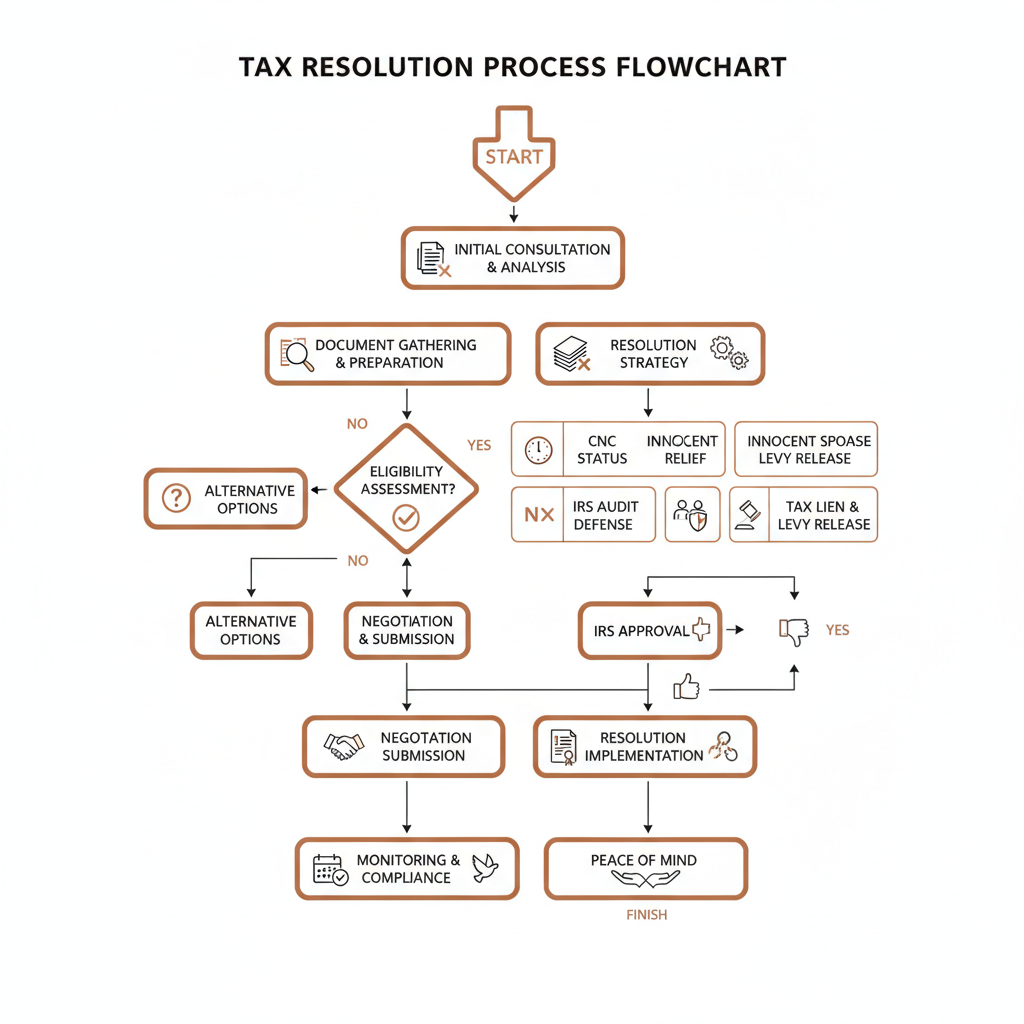
Engaging with a premier IRS tax resolution service means starting on a structured and supportive journey designed to alleviate your tax burden. This systematic approach guides you from the initial moment of concern to the final resolution, ensuring clarity and confidence at every step. We outline the typical process clients experience, highlighting the key phases and what you can expect.
The Initial Consultation: What to Prepare
The journey begins with an initial consultation, often offered as a free service. This crucial first meeting sets the stage for understanding your situation and outlining potential paths forward. To make the most of this consultation, we advise clients to come prepared with specific documentation and questions.
What to Gather:
- IRS Notices: Any letters or notices you’ve received from the IRS are vital. These documents contain critical information about your specific tax problem, including the tax years involved, the amount owed, and the nature of the issue (e.g., audit, levy, lien).
- Past Tax Returns: Copies of your filed tax returns for the years in question, and potentially a few years prior, can provide a comprehensive financial history.
- Financial Statements: Recent bank statements, pay stubs, profit and loss statements (for businesses), and lists of assets and liabilities will help the professionals understand your current financial standing. This information is crucial for determining eligibility for programs like an Offer in Compromise or an Installment Agreement.
Asking Key Questions:
This is your opportunity to evaluate the service and ensure it’s the right fit. Consider asking:
- What is your specific experience with cases like mine?
- How do you communicate with clients throughout the process?
- What is your typical process for resolving tax issues?
- What are your fees and payment options?
- What documentation will you need from me?
This preparation allows the tax professionals to quickly assess your situation, understand the scope of the problem, and begin formulating an effective strategy.
Investigation and Strategy Development
Once the initial consultation is complete and you decide to move forward, the premier tax resolution service will dig deeper into your case. This phase is critical for developing a precise and effective resolution strategy.
The first step often involves a thorough IRS transcript analysis. By obtaining and reviewing your official IRS transcripts, professionals can uncover the exact nature of your tax debt, including assessment dates, penalties, interest, and any prior IRS actions. This provides a clear, official picture that might differ from what you’ve received in notices.
Next, a comprehensive financial review is conducted. This involves analyzing your income, expenses, assets, and liabilities to determine your true ability to pay. This information is vital for:
- Determining eligibility for programs: For example, an Offer in Compromise requires a detailed financial statement to prove you cannot pay the full amount.
- Identifying potential hardship: If paying your tax debt would cause significant financial hardship, the IRS might consider placing your account in Currently Not Collectible status or offering a more flexible payment plan.
Based on this detailed investigation, the tax professionals will formulate a negotiation strategy. This strategy is customized to your unique circumstances and aims to achieve the most favorable outcome. It considers factors like the statute of limitations, the type of tax debt, your financial situation, and your compliance history. A key part of this strategy is often focused on protecting assets from potential IRS levies or seizures while the resolution process is underway. This proactive approach ensures your financial stability is maintained as much as possible throughout the resolution.
Negotiation and Final Resolution
With a solid strategy in place, the premier tax resolution service moves into the negotiation phase, acting as your direct representative with the IRS. This is where their expertise in navigating IRS bureaucracy and advocating on your behalf truly shines.
The professionals will engage in direct IRS communication, handling all correspondence, phone calls, and meetings with IRS agents. This shields you from the stress and complexity of dealing with the IRS directly and ensures that all communication is professional, accurate, and strategic.
Their primary goal is negotiating settlements that are in your best interest. This could involve:
- Submitting formal offers: Such as an Offer in Compromise, backed by detailed financial documentation and a compelling argument for acceptance.
- Establishing installment agreements: Negotiating affordable monthly payment plans that fit your budget.
- Requesting penalty abatements: Presenting a case for why penalties should be reduced or removed.
If levies or liens have been placed, the service will work diligently on releasing levies and withdrawing liens. This often involves demonstrating compliance, negotiating a payment plan, or proving that the levy or lien is causing undue hardship. For example, they might work to secure an IRS levy release to unfreeze your bank account or stop wage garnishments.
The ultimate goal is achieving compliance and closure. This means not only resolving the immediate tax debt but also ensuring that you are fully compliant with all tax obligations moving forward. A premier service will guide you through the necessary steps to prevent future tax problems, offering advice on tax planning and ongoing compliance. When the resolution is complete, you receive the peace of mind that your tax issues are behind you, allowing you to move forward with financial stability.
Strategic Considerations for Choosing Your Advocate
Choosing the right advocate for your tax resolution needs is a critical decision that can have long-lasting financial implications. Beyond the general qualities of expertise and a proven track record, there are strategic considerations that can help you select a service perfectly suited to your specific situation. This includes understanding the value of local expertise, navigating fee structures, and recognizing red flags to avoid scams.
The Value of Local Knowledge
While federal tax laws apply nationwide, the nuances of state tax laws and local economic conditions can significantly impact tax resolution strategies. This is particularly true for locations like Manhattan Beach.
A service with local expertise understands how California state tax laws interact with federal obligations. This includes knowledge of California’s unique income tax rules, sales tax regulations, and property tax considerations. For businesses, this can extend to understanding the Employment Development Department (EDD) and other state agencies.
The California tax environment is complex, and a local firm will be intimately familiar with the specific challenges and opportunities it presents. Furthermore, the Manhattan Beach business climate and its high-net-worth individuals and significant real estate transactions create unique tax situations. For example:
- Payroll taxes: Businesses in Manhattan Beach need to comply with both federal and state payroll tax requirements, which can be intricate.
- Sales tax compliance: Retailers and service providers must steer California’s sales tax regulations, which can be a source of audits and penalties.
- Real estate transactions: The high value of real estate in the area means property tax issues and capital gains taxes on sales are often substantial and require expert handling.
Choosing a service that understands these local dynamics can lead to more effective and personalized resolution strategies. They can offer insights into how local economic factors might influence your ability to pay or the types of resolutions the state might consider. This local insight can be a significant advantage over a national firm with a more generalized approach. For those dealing with California state tax issues, a specialized service can be found at California State Tax Resolution Services.
Understanding Fee Structures and Avoiding Scams
One of the most important aspects of choosing a tax resolution service is understanding their fee structure and being vigilant against potential scams. Transparency in pricing is a hallmark of a reputable firm.
Reputable firms typically offer various fee structures:
- Flat Fees: A fixed price for a specific service (e.g., preparing unfiled returns, negotiating an Offer in Compromise). This provides cost certainty.
- Retainers: An upfront payment that is drawn down as work is performed.
- Hourly Rates: Charges based on the time spent by the tax professional on your case.
When discussing fees, ensure you get a clear, written agreement outlining all costs involved. A premier IRS tax resolution service will provide transparent pricing, ensuring there are no hidden surprises. You can often find a detailed breakdown of services and associated costs on a firm’s fee schedule.
Unfortunately, the tax resolution industry is not immune to scams. Be wary of the following red flags:
- Unrealistic Promises: Claims of settling your debt for “pennies on the dollar” without a thorough review of your financial situation are a major warning sign. While significant reductions are possible, they are not guaranteed for everyone.
- High-Pressure Sales Tactics: Reputable firms will give you time to consider your options and won’t pressure you into immediate decisions.
- Upfront Fees Without Service: Some scam operations charge large upfront fees but then do little to no work on your behalf.
- Guaranteed Results: No legitimate tax professional can guarantee specific outcomes, as the IRS makes final decisions.
- Requests for Unusual Payment Methods: The IRS will never demand payment via gift cards, wire transfers, or cryptocurrency. Be suspicious if a “tax resolution” service asks for these.
To protect yourself, always check a firm’s reputation with organizations like the Better Business Bureau. Finding a service that offers transparent pricing and realistic expectations is crucial for a successful outcome.
Frequently Asked Questions about IRS Tax Resolution
We understand that navigating IRS tax issues can bring up many questions. Here, we address some of the most common inquiries we receive, providing clarity and guidance on the path to resolution.
How long does the IRS tax resolution process typically take?
The duration of the IRS tax resolution process is highly variable and depends on several factors, primarily case complexity and IRS responsiveness.
- Simple cases, such as setting up a basic installment agreement for a straightforward tax debt, might be resolved within a few weeks to a couple of months.
- More complex issues, like an Offer in Compromise (OIC), involve extensive financial documentation and IRS review. An OIC timeline can range from 6 months to over a year, depending on the volume of cases the IRS is processing and the thoroughness of your submission.
- IRS audits can also vary greatly, from a few months for correspondence audits to a year or more for field audits involving businesses.
- Generally, most IRS resolution cases, when handled by experienced professionals, fall within an average timeframe of 2 to 8 months. However, this is an estimate, and each case is unique. Factors like appeals, additional information requests from the IRS, or delays in client document submission can extend these timelines.
What is the most important first step when facing an IRS problem?
The most critical first step when facing an IRS problem is to not ignore any notices. Many taxpayers make the mistake of putting IRS letters aside, hoping the problem will go away, but it almost always escalates.
Instead, your immediate action should be to contact a professional tax resolution service. This professional can help you:
- Understand your rights: The IRS has specific procedures and taxpayers have rights, which a professional can explain and ensure are upheld.
- Assess the situation: They can interpret the IRS notice, understand the underlying issue, and gauge the severity of the problem.
- Prevent further action: Engaging a professional quickly can often halt or delay aggressive IRS collection actions like levies or liens.
- Avoid speaking directly to the IRS without representation: While you have the right to speak to the IRS yourself, doing so without professional guidance can lead to missteps or inadvertently providing information that could harm your case. An experienced representative can handle all communications, ensuring your interests are protected.
Proactive engagement with a qualified tax professional is the strongest defense against escalating IRS issues.
Can I resolve my tax debt with the IRS on my own?
While it is technically possible to resolve your tax debt with the IRS on your own, the feasibility and advisability of doing so largely depend on the complexity of your case and the amount of debt involved.
For simple cases with relatively small debt amounts, where you fully understand the issue and the available IRS programs (like a straightforward installment agreement), you might be able to steer the process independently. The IRS does provide resources and options for self-resolution, and the Taxpayer Advocate Service can offer assistance and guidance.
However, there are significant risks and challenges:
- High risk of errors: Tax law is incredibly complex, and even small mistakes in forms or financial disclosures can lead to delays, rejection of your proposed resolution, or even additional penalties.
- Complexity of tax law: Understanding eligibility criteria for various programs (like an Offer in Compromise) and the intricate rules governing penalties, interest, and collection actions requires specialized knowledge.
- Benefit of professional negotiation: Experienced tax professionals have established relationships with the IRS, understand their internal procedures, and know how to present your case most effectively. They can often negotiate more favorable terms than an individual might achieve alone. They are adept at challenging IRS positions, abating penalties, and protecting your rights.
For most individuals and businesses facing significant or complex tax problems, the benefit of professional negotiation and representation far outweighs the perceived savings of attempting self-resolution. A professional can save you time, stress, and potentially a substantial amount of money in the long run.
Conclusion
Facing the IRS can be a daunting experience, but with the right partnership, financial relief and peace of mind are within reach. A premier IRS tax resolution service offers more than just technical expertise; it provides a comprehensive, client-centric approach that steers the complexities of tax law on your behalf. From understanding the nuances of IRS liens and levies to strategically defending against audits and bringing unfiled returns into compliance, these professionals are your unwavering advocates.
We’ve explored the hallmarks of a truly premier service: essential credentials and extensive experience, a wide array of comprehensive resolution strategies, a proven track record, and transparent communication. We’ve also outlined the typical client journey, from initial consultation and meticulous investigation to strategic negotiation and final resolution, emphasizing the importance of a systematic and supportive process.
Choosing your advocate wisely means considering the value of local expertise, understanding transparent fee structures, and being vigilant against scams. The decision to seek professional help is the most important first step, ensuring that you don’t face the IRS alone. With a trusted partner by your side, you can transform a stressful tax problem into a manageable path toward financial stability and a fresh start.
If you’re struggling with tax issues, don’t hesitate to seek expert guidance. Contact us today for a confidential consultation and take the first step towards resolving your tax challenges.