
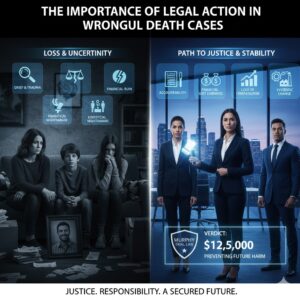
The sudden, preventable loss of a loved one creates a void that can never be filled. In the aftermath of such a tragedy, families are consumed by grief, logistical nightmares, and financial uncertainty. While no lawsuit can bring back a life, a wrongful death claim serves critical purposes that extend far beyond financial compensation. It is a formal process for establishing accountability, a mechanism for preventing future harm, and a means for securing the financial stability the deceased would have provided. Pursuing legal action is not about vengeance; it is about justice, responsibility, and fulfilling a duty to honor the lost life by ensuring that the negligence or misconduct that caused it does not go unchallenged. In a wrongful death case, the law provides a structured path for the living to seek answers, assign fault, and protect their future.
Establishing Accountability and Answering “Why?”
In the chaotic wake of a death, families are often left with incomplete information from authorities or conflicting stories from responsible parties. A wrongful death investigation, conducted through the civil discovery process, has the power to uncover the truth. Attorneys can subpoena documents, take depositions under oath, and consult experts to reconstruct events. This process can reveal hidden facts: a company’s prior knowledge of a defective product, a driver’s cell phone records proving distraction, or a property owner’s ignored warnings about a hazard. For families, this discovery provides answers to the haunting question of “why?” It transforms an inexplicable tragedy into a documented sequence of failures. Establishing legal accountability through a verdict or settlement is a formal, societal recognition that the death was wrong and preventable, which can be a pivotal step in the grieving process.
Providing Financial Security for a Lost Future
The economic impact of a wrongful death is catastrophic. The deceased may have been the primary breadwinner, a caregiver for children or elderly parents, or a partner contributing to shared household responsibilities. Their lost income, benefits, and services have a quantifiable financial value. A wrongful death claim seeks to recover these economic damages, which can include future lost earnings, loss of inheritance, and the cost of services the deceased would have provided (like childcare, home maintenance, or transportation). For a surviving spouse, children, or dependent parents, this recovery is not a windfall; it is a lifeline. It can pay for a family home, fund a child’s education, and provide stability in a world suddenly turned upside down. A Los Angeles wrongful death lawyer works with economists and financial experts to meticulously calculate this future loss, ensuring the family’s claim reflects the true magnitude of the economic devastation.
The Non-Economic Value: Loss of Companionship and Guidance
Beyond economics, wrongful death law recognizes the profound human loss. Damages can be sought for the survivors’ grief, sorrow, and mental anguish, as well as the loss of the deceased’s love, companionship, comfort, care, assistance, protection, and guidance. While no amount of money equates to a human life, these non-economic damages acknowledge the deep, personal void left behind. For a child who loses a parent, it’s the loss of mentorship and emotional support. For a spouse, it’s the loss of a life partner and shared dreams. The legal process provides a forum to articulate and validate this loss, and a financial recovery can, in a small way, provide the means for survivors to access counseling, take time to heal, and rebuild their lives in a manner that honors the relationship that was taken from them.
Driving Systemic Change and Enhancing Public Safety
Perhaps the most powerful societal function of a wrongful death lawsuit is its deterrent effect. When a corporation or individual is held financially responsible for a death, it sends a clear market signal. A substantial verdict can force a company to recall a dangerous product, overhaul its safety protocols, or retrain its employees. It can prompt a municipality to fix a dangerous intersection or improve emergency response procedures. By attaching a significant cost to fatal negligence, the civil justice system creates a powerful incentive for all entities to prioritize safety. In this way, each wrongful death claim acts as a force for prevention. The family’s pursuit of justice, therefore, serves a public good: it helps ensure that the same chain of failures does not claim another life, turning personal tragedy into a catalyst for saving others—a legacy that can bring a measure of meaning to an otherwise senseless loss.